
(Not) a Beginning or: How “French Theory” Came to America
In 1966, Jacques Derrida traveled to a conference in Baltimore and gave a lecture that would later be regarded as the birth of poststructuralism. Yet Derrida himself had called the very idea of such a fixed beginning into question.
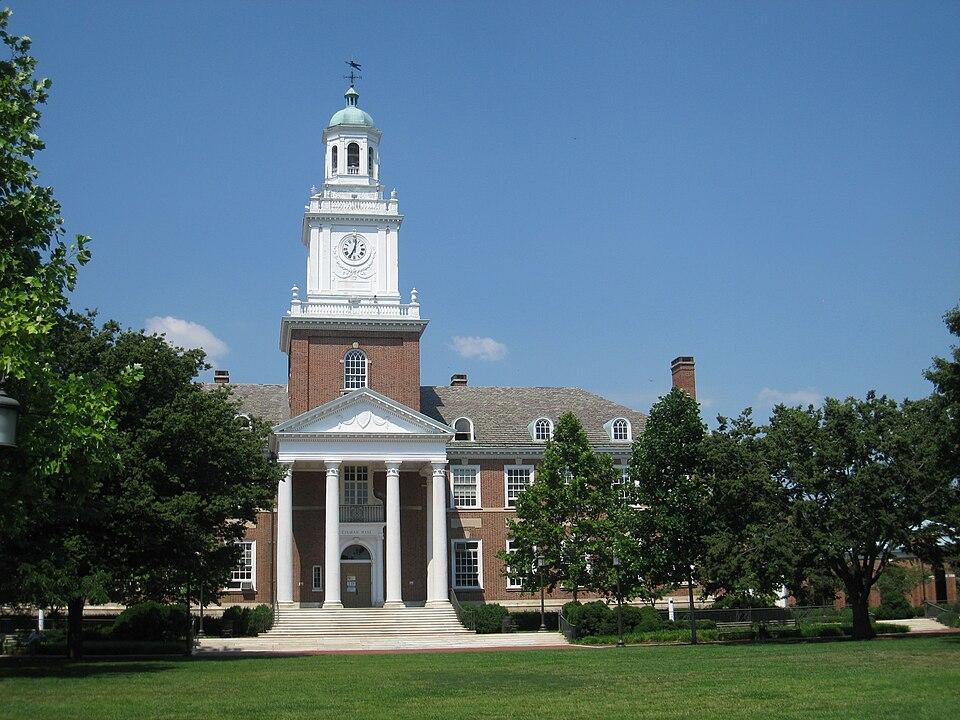
Gilman Hall, Johns Hopkins University, Baltimore, Maryland, USA — Daderot · Public Domain
Baltimore, October 1966
When Jacques Derrida traveled to Baltimore in October 1966, hardly anyone in the United States knew him. The 36-year-old philosopher was not entirely unknown in France. The three books that would really make him famous the following year – De la grammatologie, L'écriture et la différence, and La voix et le phénomène – had not yet been published. And, if one of the organizers is to be believed, he was not even the first choice.
Richard Macksey, who organized the conference at Johns Hopkins University together with René Girard and Eugenio Donato, later told the story this way: The Belgian anthropologist Luc de Heusch had initially been invited. When he declined, Jean Hyppolite, one of the most influential French philosophers of his time, suggested a former student. Derrida then accepted at short notice.
The conference was titled The Languages of Criticism and the Sciences of Man. From October 18 to 21, more than a hundred philosophers, literary scholars, anthropologists, and psychoanalysts gathered there. The turnout was so large that the Milton S. Eisenhower Library could not accommodate everyone, and the program had to be transmitted to an adjoining room. The aim of the conference was to get a better picture of what had been stirring up the humanities in France for several years: structuralism. Among those who spoke in Baltimore were Barthes and Lacan, Hyppolite, Lucien Goldmann, Tzvetan Todorov, and Jean-Pierre Vernant. Claude Lévi-Strauss, who was in a sense the "father" of structuralism in the social sciences, did not attend, however.
On the final day of the conference, October 21, Derrida gave his lecture. It was titled La structure, le signe et le jeu dans le discours des sciences humaines. This lecture would later be regarded as a kind of founding document of so-called poststructuralism – precisely the movement of thought that was often understood as an overcoming of structuralism. And Baltimore also became an important point of reference in the history of what would later become known as "French Theory" (that is, the particular reception and appropriation of French thought in the United States). But how did a relatively unknown young scholar come to criticize one of the leading schools of thought of the time so fundamentally, and at one of the largest conferences on structuralism of all, the very conference that was supposed to make structuralism known in the United States?
Structuralism
But let us start slowly. What does the term structuralism actually mean? This school of thought grew out of observations that the linguist Ferdinand de Saussure had made at the beginning of the century: A sign does not derive its value from itself, but from its position within a system of differences. Saussure compared language to a game of chess. A knight is not a knight because it is carved from wood and resembles a horse's head. If it gets lost, it can be replaced by a button, as long as everyone knows that the button now moves like a knight. What matters are the moves permitted by the rules and the relationship to the other pieces.
Something similar applies to words. At a traffic light, "red" means "stop" not because of any natural property of the color, but within a system in which it differs from "green" and "yellow." Meaning arises from relationships.
The ethnologist Lévi-Strauss later applied this way of thinking to cultures. In his book The Raw and the Cooked, for example, he examined South American myths and asked not only what individual stories "mean," but how they relate to one another. Cooking, for instance, appeared in these myths as a transition from nature to culture: raw is what is given by nature, cooked is what has been transformed by human beings. Behind the diversity of narratives, he suspected fundamental structures of which the storytellers themselves were not aware.
Many researchers found this attractive. The sciences of man (the Sciences of Man from the conference title) could thus – perhaps – be placed on a solid foundation of fundamental rules, orders, and distinctions. One such distinction that Lévi-Strauss used, and that would soon become important in Baltimore, was the distinction between nature and culture: Nature was what is universally given, and culture what human beings organize through rules and what can differ between societies.
A Fixed Point
Let us now return to Derrida's lecture. In it, Derrida takes a closer look at the concept of structure and observes that, throughout the history of Western thought, structures have usually been organized around a fixed point of reference. Derrida names several concepts under which this point of reference appeared in the history of philosophy: eidos, archē, and telos, later substance, truth, subject, consciousness, God, man. What all these different concepts had in common, he argued, was that they functioned as a center. This center was supposed to organize the elements of language and thought and limit the interplay between them. It was supposed to provide a final point of stability and a fundamental orientation.
“The center is not the center.”
— Jacques Derrida
A simple example would be a Christian worldview in which everything created had its place within an order sustained by God. God was not merely one element alongside human beings, animals, and things. Precisely because he was supposed to ground the order, he had to possess a different status from that which was ordered through him.
In this idea, however, Derrida saw a contradiction. On the one hand, the center was regarded as something that belonged to the structure, since it was supposed to organize everything else. At the same time, however, it could not be subject to the same rules as the other elements, because otherwise it would itself be replaceable and could no longer function as a fixed point. Derrida summed up this contradiction in a formula: "The center is not the center." That is, the center was understood as existing both within the structure and at the same time outside the structure.
The "Event"
This problem in the concept of structure, or rather of the center, had existed for a very long time. In modern times, however, according to Derrida, an "event" had occurred in the history of the concept of structure. By this term, Derrida meant that a shift in the understanding of the concept had taken place, one that could not, however, be directly associated with a single moment or thinker.
This shift or change consisted, according to Derrida, in the fact that, for the first time, an old idea of a center was not simply replaced by a new one. Not simply "God" as the center replaced by "man" as the center. No, what was truly new was that the function of the center itself had become questionable. Thinkers such as Nietzsche, Freud, and Heidegger no longer simply asked what should stand at the center, but why a structure needed such a fixed and privileged point at all.
“Meanings had always been embedded in a web of relationships and references.”
From here, we can also understand the concept of "play" in the title of the lecture. According to Derrida, a play of relationships, shifts, and replacements of meaning had always been at work within a structure. Western philosophy, however, had tried to limit this play through the idea of a fixed center. The center itself was supposed to stand outside these movements and offer a final, unchanging point of stability. That precisely this limitation was artificial, that is, an illusion intended to limit the free and uncontrollable play of the shifting meanings of concepts – this, according to Derrida, was what now became visible through thinkers such as Nietzsche, Freud, or Heidegger.
To better understand what Derrida means by this free play of shifts in meaning, a dictionary is a helpful analogy. A dictionary does not contain an infinite number of words; it is therefore limited. Nevertheless, when looking up words, we never arrive at a final word that explains all the others and itself requires no further explanation, that is, at a kind of center. Instead, each word refers to other words, which in turn refer to further words. The words thus form a network of relationships, without any single word being able to serve as a final point of reference. Something similar, according to Derrida, also applies to language and thought in general: Meanings had always been embedded in a web of relationships and references. The idea of a fixed center, however, concealed the fact that there is no final point at which this referring could come to a definitive stop.
This does not mean, however, that every word could mean anything. Words have a history, context, and use. Derrida's question was a different, more limited one: Can mutual understanding be secured by a final authority that itself requires no further relationship and no further interpretation? And to this question, his answer was negative.
Bricolage and Deconstruction
To substantiate this negative answer and its radical consequences more precisely, Derrida takes a closer look at Lévi-Strauss's work. As we have seen, one of the cornerstones of his work was the distinction between "nature" (what is biological and the same everywhere) and "culture" (what varies from society to society through social rules).
In his research, however, Lévi-Strauss encountered a problem that he himself called a "scandal": the incest prohibition. This rule is, on the one hand, culture, because it is a social law made by human beings. On the other hand, it is nature, because it can be found in every single human society without exception and is therefore universally valid. One and the same thing thus suddenly belonged in both categories of a distinction that was supposed to be clear-cut. The foundation of his structure began to shake. But instead of throwing away his entire theory, Lévi-Strauss chose a pragmatic approach: He kept the flawed distinction and simply continued to use it as a mere tool, even though he no longer believed in its absolute truth.
It is precisely at this point that Derrida connects the example to his central argument and introduces the concept of bricolage, or tinkering. Lévi-Strauss, according to Derrida, does not work here like an infallible scientist, but like a tinkerer. A tinkerer never starts from zero. He does not design perfect, new tools in a vacuum, but looks around his workshop and uses the material that is already there, even if it is actually imprecise or incomplete for the task at hand.
“No one can begin to think outside existing language.”
Derrida radicalizes this thought and argues: This tinkering concerns all of us, particularly in language. He contrasts the tinkerer with the ideal figure of the "engineer" – a thinker who could create his concepts and his language entirely freely, purely logically, and absolutely without error out of nothing. But such an engineer, Derrida's point is, is himself a myth. No one can begin to think outside existing language. When we want to name new phenomena, we do not invent a new language, but "tinker" with old concepts. This becomes clear today, for example, when we describe digital tools using terms such as "mouse," "window," or "trash can." We make the new thinkable only through the old.
The example of Lévi-Strauss thus becomes a fundamental insight for Derrida's own method: There is no absolutely pure, neutral place outside language and history. Anyone who wants to criticize a philosophical tradition or a system does not possess a "higher," untainted language. One must work with precisely the concepts and tools that come from the tradition one actually wants to question. One must tinker with the imperfect tools that are already lying in the workshop. It is precisely this movement – not blindly attacking a system from the outside, but using and tracing its own concepts until it reveals its own contradictions from within – that would become world-famous under the name "deconstruction."
Two Ways of Living the Play
How, then, should we respond to this insight that a fixed center is an illusion, that there is instead an unlimited play of meanings, and that meaning is subject to significant changes? Derrida gives no clear answer. At the end of his lecture, he distinguishes between two attitudes toward this insight. The first experienced the loss of stability as a lack and continued to search behind the signs for an original truth or immediate presence. He associated this attitude with Rousseau and Lévi-Strauss. The other affirmed the play without hoping for a return to the origin; Nietzsche stood for this attitude.
“The irony of history was that his own appearance was retrospectively declared to be precisely such an absolute origin.”
One might expect Derrida to now clearly side with Nietzsche's radical way of thinking. But he does not. For Derrida, it is impossible to simply leave behind the longing for a fixed truth, since our entire thinking and our language are built upon it. His real appeal is therefore this: We must endure the fact that we find ourselves in a transitional period in which both attitudes exist at the same time. We can no longer deny the free play of meanings, but neither can we immediately cast off the old search for a fixed point of stability. At the end of the lecture, Derrida suggests that an entirely new, still unknown form of thinking will emerge from this contradiction. But since we cannot yet name or comprehend this future, he describes it as something uncanny and formless – as a "monstrosity."
The Discussion
After Derrida had finished his lecture, a short but consequential discussion followed. His former teacher, the philosopher Jean Hyppolite, took up the problem of the center and introduced a counterexample from physics: Einstein's theory of relativity. In this theory, there is no longer a fixed, absolute center in the universe from which everything is measured. But there are mathematical constants (such as the speed of light) that never change, regardless of where one measures from. Hyppolite's question was clever: Could such an unchanging constant not take on the function of a new, more modern center? Does science not provide us with a final point of stability after all?
Derrida firmly disagreed. For him, such a constant was the exact opposite of a center. A traditional center is a divine, privileged point that stands absolutely above things and governs everything. Einstein's constant, by contrast, governs nothing; it is merely a rule that describes how different systems relate to one another. According to Derrida, it is not the anchor of the structure, but the very concept of "play" itself – the rule according to which meanings constantly shift.
Hyppolite's objection nevertheless touched a sensitive nerve of the entire project: Can an order really be thought of entirely without a center, or does the center merely return in modern science and philosophy in a much more abstract, invisible form? This question was not resolved in the discussion and would continue to accompany Derrida's philosophy.
When Hyppolite finally wanted to know where Derrida actually intended to go with this radical direction, Derrida gave an answer that would become famous: He was trying to bring himself to a point where he himself no longer knew where he was going. What sounds like an evasion was the logical consequence of his entire lecture. Had Derrida proclaimed a clear, new goal or a new philosophical system, he would have repeated precisely the mistake he was criticizing: He would merely have replaced the old center with a new center.
The Legend of Baltimore
To understand the significance of this lecture, we must consider the "official story" that is still often told about this conference in intellectual history. It is a dramatic legend: A renowned American university invites the absolute elite of French intellectuals in 1966 to ceremoniously introduce structuralism to the United States. But on the final day, a then almost unknown substitute named Jacques Derrida takes the stage. In a single lecture, he dismantles the fundamental concepts of the invited star guests and proves that their structures have no fixed foundation. The official narrative therefore goes like this: Structuralism came to America to make a triumphant entrance – and was buried by Derrida at its own welcome party. In this legend, Baltimore is considered the exact historical "zero point" at which poststructuralism was born.
At the same time, the conference later came to be seen as an important starting point of what became known as "French Theory." This term refers to the particular way in which French thinkers such as Derrida, Barthes, Lacan, Foucault, and Deleuze were received in the United States. Their texts were translated, discussed at American universities, and brought together in new ways, especially in literary and cultural studies. Out of different French approaches to thought, something emerged that had never existed in quite this form in France itself. "French Theory" was therefore, in a sense, an American invention made from French ideas. Books, translations, and seminars in the following years (such as the famous translation of Derrida's Of Grammatology in 1976) seemed to retrospectively cement Baltimore's role as the historical starting point of this development.
This story, however – considered entirely in the spirit of Derrida's own philosophy – is far too orderly. It artificially tries to pin down a complex development to a single, neat origin. On closer inspection, this clarity falls apart in the play of historical references. Structuralism itself was not a closed unity; there was no single, unified school of structuralism that could have been brought to an end in one afternoon. Derrida himself never wanted to found a new school called "poststructuralism" , he instead called his philosophical approach "deconstruction." Nor did the exchange across the Atlantic begin only in 1966; Lévi-Strauss had already taught in New York during the Second World War and worked there with the linguist Roman Jakobson. There was therefore no radical break out of nothing, but a long, widely branching network of influences and texts that had already been in motion long before Baltimore.
This "official history" retrospectively turned the place Baltimore into a new "center," that is, a fixed, unshakable point of reference meant to organize and explain an entire era.
In doing so, Baltimore takes on exactly the contradictory role that Derrida had attributed to the center: On the one hand, the conference belongs to real history; it took place there and forms one element in the chain of events. On the other hand, it is treated as something that stands outside this history, as a magical origin that explains itself and requires no further explanation of where it came from. But Baltimore did not yet possess this special role as a "center" in 1966. It was only retrospectively assigned to the place through later narratives, myth-making, and quotations. Derrida had begun his lecture with the insight that there is no absolute, first origin in language. The irony of history was that his own appearance was retrospectively declared to be precisely such an absolute origin.
The center was not the center.